

Illegal Buildings Greece – The Complete Legalisation Guide by Samos Housing
Do you own a property in Greece with an illegal building, an unpermitted extension or an unauthorised structure? You are far from alone — and crucially, there is a legal solution. Greece has been dealing with a massive legacy of illegal buildings for decades, and the current law gives most property owners a clear pathway to full legalisation. However, the deadline is rapidly approaching. Samos Housing's licensed engineers handle the entire process on your behalf — from on-site survey to final certificate. Meanwhile, if you are also looking to buy or sell property on Samos, our team covers every step of that process too.
Why Does Greece Have So Many Illegal Buildings?
Building permits became mandatory in Greece in 1955. However, the cultural and practical adaptation to this requirement was slow — particularly in rural areas and on islands like Samos. Throughout the 1960s, 1970s and 1980s, a very large number of homes, extensions and outbuildings were consequently erected without permits. At the time, enforcement was minimal and the legal consequences were not immediate — so the practice became widespread across the country.
Furthermore, a common reason you see so many unfinished buildings in Greece is directly related to this issue. Property owners who ran out of funds during construction would deliberately leave a building unfinished — specifically to avoid paying local property tax, which only applied to completed structures. As a result, roofless or partially built concrete structures became a familiar feature of the Greek landscape. In addition, many permitted buildings were later expanded with illegal extensions — an extra floor, a veranda or a basement that was never declared or approved.
By 2010, the scale of the problem was so significant that the Greek government was forced to act decisively. Consequently, from 2011 onwards, no property with an unpermitted building or undeclared illegal extension could legally be sold, transferred, rented or mortgaged without first obtaining a certificate of legal compliance from a licensed engineer. If you are currently trying to sell a property in Greece, see our property listings and property valuation services — legalisation is often the first step before a sale can proceed.
The Three Legalisation Laws – A Brief History
Since 2010, the Greek government has passed three successive laws giving property owners the opportunity to regularise illegal buildings and unauthorised constructions by hiring a licensed engineer, producing plans and paying a calculated fine. Each law extended the scope and deadline of the previous one. The official declaration process is managed through the Technical Chamber of Greece (TEE) platform on gov.gr.
-
>Law 4014/2011 — the first major amnesty law. Property owners could declare illegal structures, pay a fine and receive a temporary suspension of demolition orders. This was the law that first tied survey topography plans and engineer certifications to all property transactions in Greece.
>Law 4178/2013 — extended the amnesty framework and introduced structured fine calculations based on building age, location and size. Older illegal structures consequently attracted significantly lower fines than recently built ones.
>Law 4495/2017 — the current main framework. This law introduced the five-category classification system for illegal constructions, stricter controls and the requirement for the Electronic Building ID alongside the legalisation certificate. It remains the primary legislation today.
>Law 5106/2024 — the most recent update. It introduced a new national electronic registry of illegal constructions, instalment payment options for fines, reductions for low-income owners and disabled persons, and stronger environmental controls. The Greek Ministry of Environment and Energy oversees all related enforcement and policy.
The 2027 Deadline – Act Now
This is the most urgent issue for any Greek property owner with an illegal building or unpermitted extension. The deadline for legalising unauthorised constructions in Categories 1–4 has been extended to 31 December 2027 — with all supporting documentation deadlines extended by an additional 36 months. However, a 40% fine surcharge already applies to all submissions from October 2024 onwards. Therefore, waiting only increases your costs — the fine itself does not decrease as the deadline approaches.
Moreover, Category 5 — which covers large-scale illegal buildings and structures with serious planning violations — has been frozen since autumn 2020. This affects thousands of private properties across Greece, but also public buildings including schools, municipal offices and hospitals built without permits. As reported by Greek financial newspaper Oikonomikos Tachydromos, millions of properties remain affected and the government is under significant pressure to resolve the issue before the current deadline expires.
The key rule that does not change: only buildings erected before July 2011 can be legalised under current Greek law. Any unauthorised construction built after that date cannot be regularised and is consequently subject to demolition. If you own a property built partially or fully without a permit before July 2011, acting before the deadline is essential — because once it passes, affected properties cannot be sold, transferred or mortgaged.
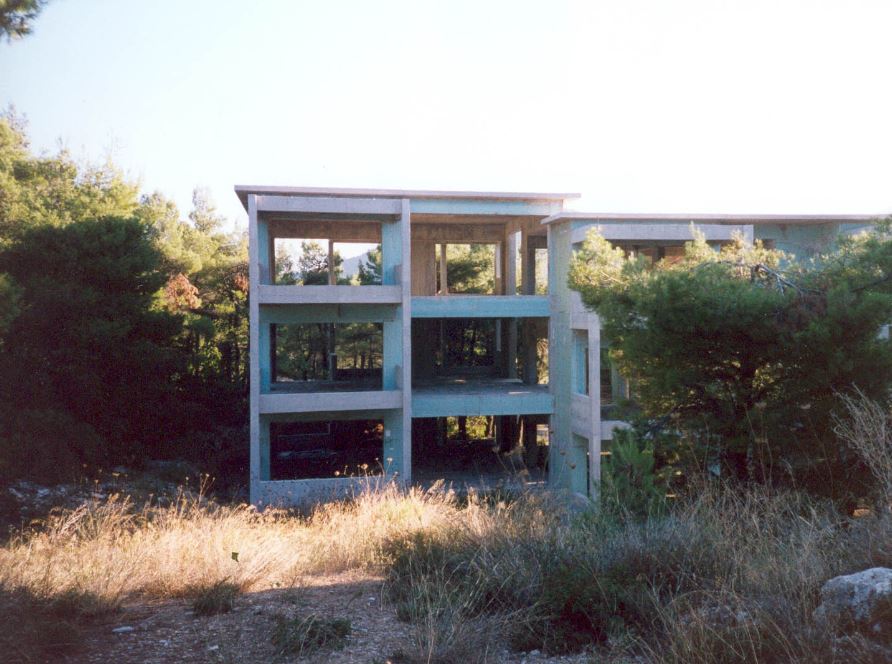
An unfinished unauthorised concrete structure — a common sight across Greece since the 1970s. Source: To Vima
The Five Categories of Illegal Buildings Greece
Under Law 4495/2017, all illegal and unauthorised constructions in Greece are classified into five categories based on the severity of the violation. This classification directly determines the fine amount and whether legalisation is possible at all. Specifically, the categories are:
-
>Category 1 — Minor violations such as small technical deviations from the approved permit. These attract the lowest fines and are the most straightforward to legalise.
>Category 2 — Small excess construction — for example a house with a slightly larger footprint than approved, or a minor illegal extension. Fines are calculated per square metre of illegal area.
>Category 3 — Medium-scale violations, including significant illegal extensions, undeclared floors or major changes of use. Fines are consequently higher and the engineering process more detailed.
>Category 4 — Older illegal structures built before 1983. These benefit from significantly reduced fines because of their age. Many traditional stone houses on Samos Island fall into this category — and therefore represent some of the most cost-effective legalisation cases on the island.
>Category 5 — Large-scale illegal buildings or structures with very serious planning violations. Currently frozen since 2020 — these cannot be legalised until new legislation is passed. For advice on new construction and building permits on Samos, see our dedicated engineering page.
How Fines Are Calculated
The fine for legalising an illegal building in Greece is not a flat amount — it is calculated individually for each property by a licensed engineer using a standardised government formula. Specifically, the key factors that determine the fine are:
-
>Size of the illegal area — the fine is calculated per square metre of unpermitted construction.
>Year of construction — the older the illegal structure, the lower the fine. Buildings erected before 1983 consequently attract the most significant reductions under Category 4.
>Location and tax zone value — properties in high-value zones (urban centres, coastal areas, tourist locations) attract higher fines than rural or remote properties.
>Type of use — residential use is treated more favourably than commercial, industrial or tourist use.
>Category classification — the higher the category, the higher the fine multiplier applied.
>40% surcharge from October 2024 — a 40% fine surcharge applies to all new submissions from 1 October 2024. Therefore, the sooner you submit, the lower the additional cost burden.
Fines can be paid in a single payment or in monthly instalments under Law 5106/2024. Additionally, reduced fines apply to low-income owners and people with disabilities. Contact us for a free initial fine estimate for your specific property.
Our Legalisation Process – Step by Step
Samos Housing handles the complete legalisation of illegal and unpermitted buildings in Greece from start to finish. Our licensed civil engineers manage every step — you do not need to deal with the Technical Chamber of Greece, the municipality or any government platform directly. All submissions go through the official TEE arbitrary buildings platform on gov.gr. Specifically, the process works as follows:
-
>Step 1 – Initial assessment: We visit the property and review all existing documents — deeds, building permits, old plans and ownership history. We consequently identify all illegal elements and determine the applicable category and estimated fine.
>Step 2 – On-site survey and measurement: Our engineers measure the entire property using Theodolites, GPS equipment and where needed LIDAR 3D building mapping — producing accurate as-built drawings of the structure exactly as it exists today.
>Step 3 – Fine calculation: We calculate the exact fine using the official government formula, taking into account all available reductions based on age, location and size.
>Step 4 – Document preparation: We prepare all required plans, technical reports and declarations for submission to the Technical Chamber of Greece (TEE).
>Step 5 – Submission and payment: We submit the complete file on your behalf. You pay the fine — in full or in instalments. We furthermore manage all follow-up with the authorities.
>Step 6 – Certificate of legalisation: Once the fine is paid and the file accepted, you receive the official legalisation certificate. Your property is consequently free to be sold, transferred or mortgaged.
>Step 7 – Electronic Building ID: After legalisation, we produce the mandatory Electronic Building ID (Ταυτότητα Κτιρίου) — required for any property sale in Greece from April 2022. We also handle Greek Cadastre registration if your property is not yet registered.
Illegal Buildings on Samos Island
Samos Island has a particularly high concentration of properties affected by the illegal building problem. The rapid development of the island in the 1970s and 1980s — combined with limited planning enforcement at the time — resulted in a very large number of homes, holiday cottages and agricultural buildings being erected without permits or with significant illegal extensions. Furthermore, many traditional stone farmhouses in mountain villages predate the 1955 permit requirement entirely and therefore fall into Category 4 — making them among the least expensive cases to legalise in all of Greece.
Additionally, a significant number of properties on Samos were built partially within forest zones or stream buffers — areas where construction was never legally permitted. These cases require special handling and in some instances cannot be fully legalised. Samos Housing knows every zone, every village boundary and every local regulation on the island. As a result, we give you the most accurate picture of what is and is not achievable for your specific property before you commit to the process. If you are currently looking to browse available properties on Samos, our listings team flags all legal compliance issues upfront.
Can I Sell a Property With an Illegal Building in Greece?
No — not without a certificate of legal compliance. Since 2011, Greek law prohibits the sale, transfer, donation or mortgaging of any property with undeclared illegal structures. Specifically, any notary in Greece will require one of the following before signing a sale contract:
-
>A certificate of legalisation — confirming that all illegal elements have been formally regularised and fines paid.
>An engineer's certificate of legal status — confirming that the property has no illegal structures whatsoever.
>An Electronic Building ID — mandatory for all property sales in Greece from April 2022. See our full guide on the Electronic Building ID Greece.
Moreover, if you are buying a property in Greece, commissioning an independent pre-purchase building inspection before signing anything is essential. Our engineers identify any illegal structures, quantify the legalisation cost and confirm whether the property can be fully regularised — protecting you from a very expensive post-purchase surprise. Once legalised, our certified property valuers can produce a formal valuation for mortgage, sale or inheritance purposes.
Services & Fees
| Service | Starting Fee | Who Needs It |
|---|---|---|
| Illegal Building Assessment & Fine Calculation | On request | All owners with unpermitted structures |
| Full Legalisation Service (Categories 1–4) | On request | Properties with illegal buildings or extensions |
| Pre-Purchase Building Inspection | €350 + VAT | Buyers checking legal status before purchase |
| LIDAR 3D As-Built Building Survey | On request | Complex buildings requiring precise mapping |
| Electronic Building ID Greece | €500 + VAT + €20 gov fee | Required for all property sales after legalisation |
| Survey Topography Plan Greece | €250 + VAT | Mandatory submission document for legalisation |
| Certified Property Valuation | On request | After legalisation, for sale or mortgage |
| New Construction & Building Permits | On request | Building legally from scratch on Samos |
Frequently Asked Questions
Can all illegal buildings in Greece be legalised?
No. Only buildings erected before July 2011 can be legalised under current Greek law. Furthermore, buildings in protected areas such as forest zones, archaeological sites or flood plains face additional restrictions and in many cases cannot be fully regularised. Our engineers assess your specific property and give you a clear answer before any costs are incurred.
What is the current deadline for legalisation?
The current deadline for Categories 1–4 is 31 December 2027, following the latest extension confirmed in late 2025. However, a 40% fine surcharge applies to all submissions from October 2024 onwards — so acting sooner is always cheaper. The deadline may change again, but fines will not decrease.
What happens if I miss the deadline?
Properties with unlegalised illegal structures that miss the deadline will be blocked from sale, transfer, donation and mortgage. In addition, authorities will be empowered to issue demolition orders. Therefore, acting before the deadline is strongly in your financial and legal interest.
How long does the legalisation process take?
For straightforward Categories 1–3, the process typically takes 4–8 weeks from initial site visit to final certificate, provided all documents are available. More complex cases with missing permits, boundary disputes or Category 4 age verification take longer. We give you a realistic timeline at the assessment stage.
Do I need a new survey plan for legalisation?
Yes — in most cases. A certified survey topography plan with EGSA 87 GPS coordinates is a mandatory submission document for the Technical Chamber of Greece (TEE). If your existing plan predates 2012 or lacks GPS coordinates, we produce a new one as part of the legalisation service.
Is legalisation different from getting a new building permit?
Yes — they are completely different processes. Legalisation regularises a structure that already exists without a permit. A building permit is required for any new construction or approved extension. In some cases, after legalisation is complete, you may then apply for a permit to extend or renovate the building further.
Act Before the Deadline Closes
The window to legalise illegal buildings in Greece is closing. Whether you are a Greek property owner, an expat, a foreign buyer or an investor, the cost and complexity of legalisation only increases the longer you wait. Samos Housing's licensed engineers are permanently based on Samos Island and cover all of Greece — giving you local expertise, full English-language support and a single point of contact for the entire process. If you are also planning to sell your property after legalisation, our estate agents are ready to list it immediately.